Asia Dialogues



From the Implementation Table to the Decision Table
India's more than 1,800 Global Capability Centres generated USD 46 billion in revenue in 2024, a figure projected to hit USD 99 billion by 2030. But two decades of scale hasn't bought GCC leaders a seat at the strategy table. "Leaders in the GCC space need to be on the decision-making table, not just the implementation table," says Saurabh Singhvi, Managing Director at Litera.
India's Global Capability Centres have spent two decades proving their technical worth. The conversation has now moved to something harder: whether GCC leaders have the influence to match the capability they have built.
For nearly twenty years, India's GCC ecosystem operated with a clear mandate: execute efficiently, scale reliably, and deliver technical excellence at global standards. By almost every measurable metric, it succeeded. India now hosts more than 1,800 GCCs employing millions of professionals across engineering, cybersecurity, finance, analytics, and product development.
The sector generated USD 46 billion in revenue in 2024 and is projected to reach USD 99 billion by 2030. Global firms no longer see India merely as a support location. In many industries, India has become the operational backbone of the enterprise itself.
Yet across leadership conversations convened through the Asia Dialogues Forum in Ahmedabad, Bengaluru, Pune, and Hyderabad, a more difficult question has begun to emerge.
What happens after capability has already been proven?
The Capability Trap: Execution Without Authority
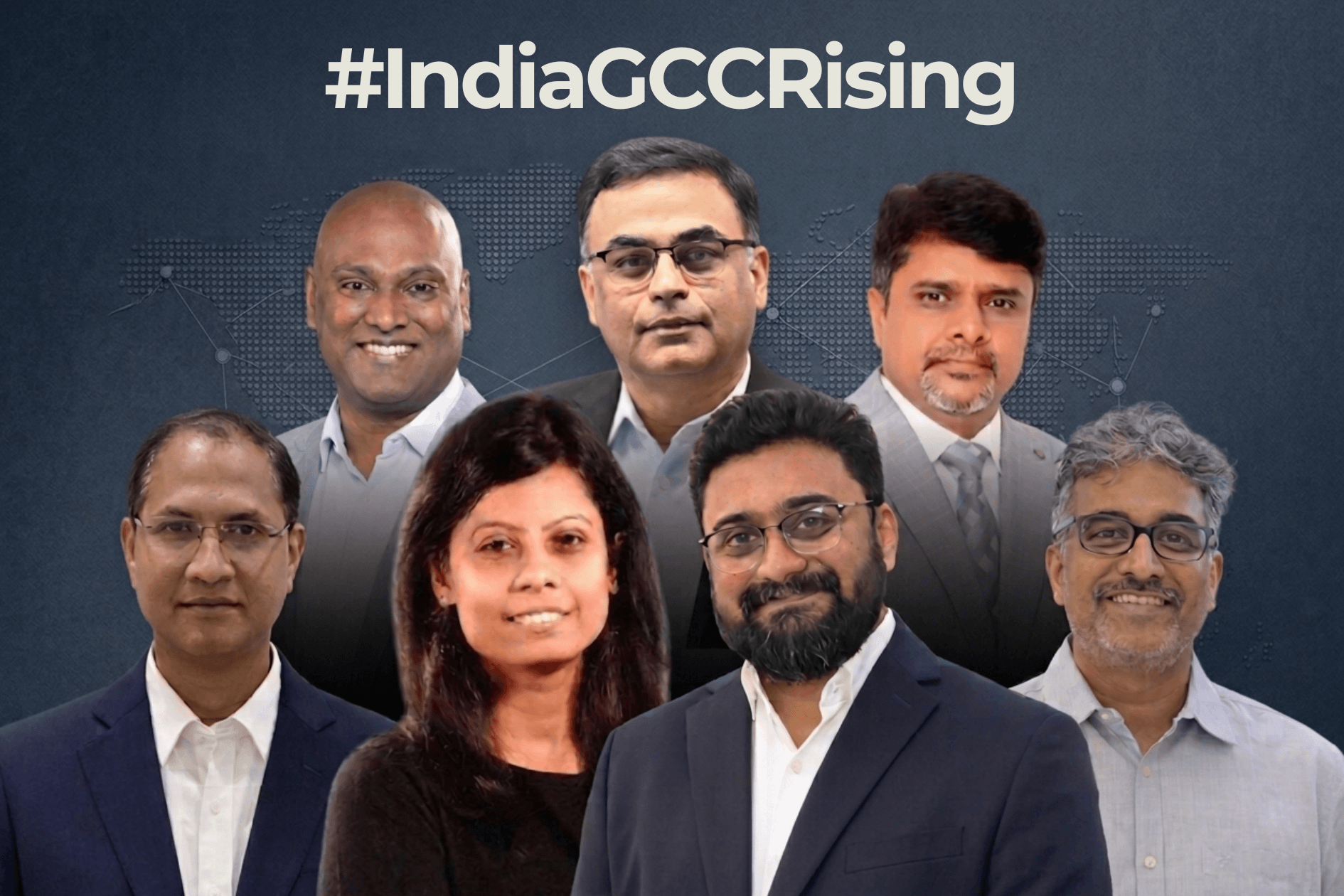
The central tension in India's GCC story was named with precision in Ahmedabad, where Saurabh Singhvi of Litera and Sudesh Jain of Adani Group spoke from direct operational experience. The forum confronted the question directly: has India's capability centre ecosystem truly moved beyond cost arbitrage, and if so, how do GCC leaders ensure they have the influence to match their capability?
GCCs are starting to drive strategic value, but are not there yet. The biggest opportunity is changing the narrative from reducing cost to generating revenue and increasing overall impact. Leaders in the GCC space need to be on the decision-making table, not just the implementation table." — Saurabh Singhvi, Managing Director, Litera
That distinction matters more than it once did. The rise of AI, automation, and digital platforms is compressing the distance between operational knowledge and strategic value creation. The teams closest to implementation often possess the clearest understanding of customer behaviour, enterprise workflows, and system-level risks. Yet in many organisations, authority has not evolved at the same pace as capability. Strategy is still often defined elsewhere. Execution still happens here.
The Agentic AI Moment: What Changes Everything
Sudesh Jain of Adani Group placed the GCC evolution in the context of a 25-year technology cycle. Each wave ERP, workflow automation, BPO, RPA, generative AI, and now agentic AI has shifted the nature of work rather than eliminating it.
Digital transformation is not new. It has evolved continuously over 25 years. From ERP to workflow automation, RPA, and now AI, every technological wave brought fears of job losses. Based on practical experience, none of these technologies eliminated jobs. They changed the way people work. Careers survive through continuous learning and re-skilling." — Sudesh Jain, COO GCC, Adani Group
But agentic AI represents something qualitatively different: autonomous systems that can orchestrate complex workflows without human intervention at each step. This is not a productivity tool. It is an architectural shift that redefines what GCCs are fundamentally for. The GCCs that recognise this early are already moving from deploying agent ecosystems to designing them, from implementing global strategy to co-authoring it, from output metrics to full P&L ownership.
India's Process Advantage as Strategic Asset
In Pune, the forum identified something that the GCC ecosystem has consistently undervalued: twenty years of accumulated process knowledge. India has been the back office of the world for two decades, building unparalleled expertise in hire-to-retire, procure-to-pay, and record-to-report workflows. In an AI-first world, that institutional depth is not a legacy. It is a moat.
India is well-poised to capitalise on the application of large language models. The biggest impact will be in enterprise AI hire to retire, procure to pay, record to report. India has the talent and process understanding to reimagine these. Future applications will be AI-led, and agents will handle conversations, mimicking human voice and empathy." — Subhayu Mukharji, Managing Director, PwC
The organisations that unlock this advantage are those that stop treating process expertise as a cost centre and start treating it as the foundation for AI-native product development. India does not need to start from scratch. It needs to build forward from what it already knows better than anyone.
Decision Velocity: The New Measure of GCC Value
In Bengaluru, the forum identified a concept that reframes how GCC performance should be evaluated entirely. The question is no longer how efficiently a GCC executes a given process. It is how significantly a GCC accelerates the quality and speed of enterprise decision-making.
Kedar Deo of Tech Mahindra framed this with a clarity that the room immediately recognised: "The organisation that can process data, surface insight, and commit to action fastest wins. AI should reduce decision nodes, not just reduce costs.
That shift from cost reduction to decision velocity changes the entire conversation about what GCCs are for. A GCC measured by cost efficiency will always be under pressure from lower-cost alternatives. A GCC measured by how significantly it improves enterprise decision quality has no natural competitor. Bengaluru forum leaders noted that 17% of global GCC leaders already operate from the city, running global procurement, finance, and technology functions. The infrastructure for decision-making authority already exists. What is required now is the organisational will to claim it.
The Human Side of Strategic Influence
The conversations also revealed that the transition from implementation to decision is not only organisational. It is deeply cultural. For years, GCC leadership was rewarded for predictability, operational discipline, and delivery excellence. Those capabilities remain essential, but strategic influence requires a different set of behaviours: commercial judgment, narrative ownership, risk appetite, and the confidence to challenge assumptions that originate from headquarters.
In Ahmedabad, Dr. Ankita Singh of Relevance Lab named a parallel challenge that compounds this: in the race to acquire AI-ready talent externally, organisations are overlooking the people already inside those who carry institutional knowledge, cultural context, client relationships, and system understanding that no external hire can replicate.
We are focusing too much on getting rather than building. People are being developed and managed outside of the system more than inside. We have enough talent and will always have enough. The question is whether we are introducing a format that builds talent from the inside." — Dr. Ankita Singh, Chief People Officer and Board Member, Relevance Lab
Younger professionals entering GCC ecosystems no longer see themselves as participants in a back-office economy. They expect ownership, visibility, and proximity to decision-making. The institutions that cannot provide that evolution face a different kind of risk: not capability loss, but ambition loss.
The Next GCC Era
The most important insight to emerge from the Asia Dialogues Forum conversations may be that India's GCC story is no longer primarily an economic story. It is becoming a leadership story.
For two decades, India's GCC ecosystem focused on proving technical credibility to the world. That phase is largely complete. The harder transition begins now. Because moving from the implementation table to the decision table requires more than capability alone. It requires organisations to redistribute trust, influence, and institutional authority in ways many global enterprises are still learning to navigate.
The defining GCCs of the next decade may not be the ones with the largest teams or the lowest operating costs. They may be the ones closest to the decisions shaping the future of the enterprise itself.
 You might be interested in




Our Partners
Leading brands who have partnered with us.













Latest News
Latest updates, insights, and highlights from our leadership community