Asia Dialogues



The Great Integration: Technology, Talent, and Transformation in Asia (Ahmedabad Edition)
Fifteen leaders from manufacturing, banking, healthcare, legal technology, EV infrastructure, defence electronics, dairy and professional services gathered in Ahmedabad to discuss how India's enterprises can make transformation deliver real business results.
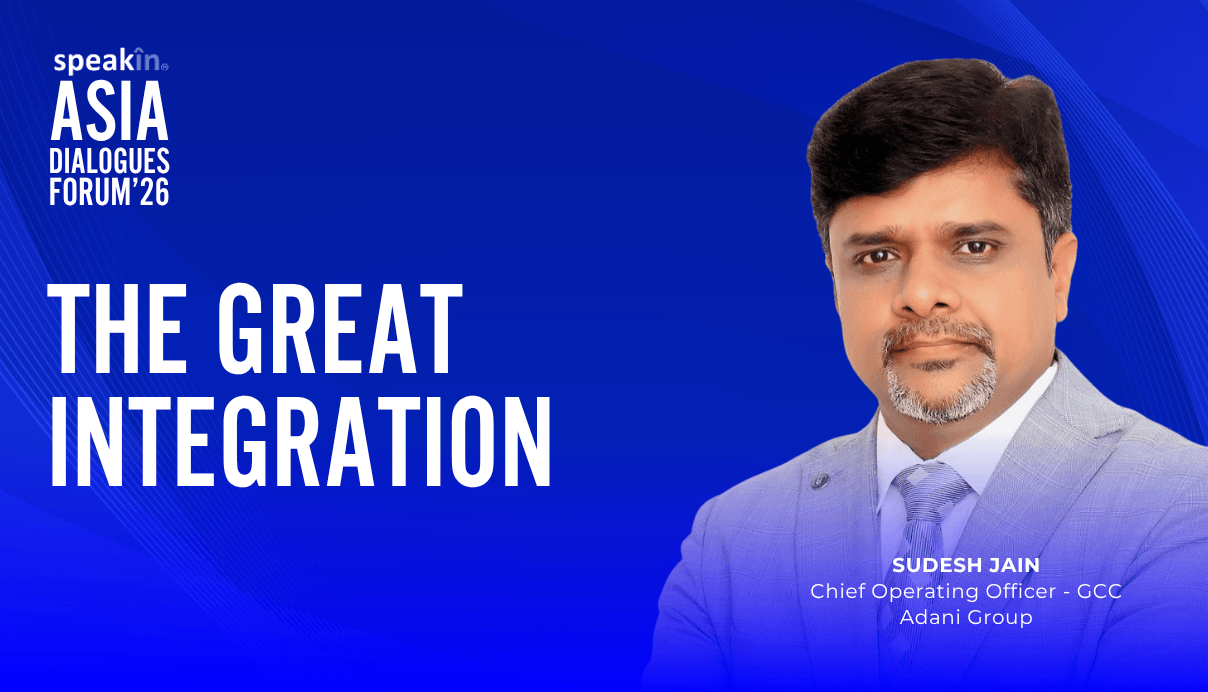
Ahmedabad has always been a city where ideas become enterprises. Once known as the Manchester of the East, it is now home to industrial groups, pharmaceutical leaders, fintech firms and a growing GCC presence, with GIFT City adding an international financial dimension. Leaders at the February 2026 edition of the SpeakIn Asia Dialogues Forum brought case studies rather than theory, and one framework came to define the discussion.
"Successful business outcomes depend on aligning the three T's: Talent, Technology, and Transformation, to achieve the fourth T: Turnaround. These elements often operate in isolation, leading to disconnects between what technology teams build and what businesses actually need." Kishore Upadhyay, Director, Factory and SCM, Otsuka Pharmaceutical India
Bhupendra Pant, CTO of Patel Infrastructure, approached the same problem from a technologist's perspective. Billions are spent on technology globally, he noted, yet when organisations ask whether the intended benefits were realised, the story is rarely exciting. Technology, people and process must be continuously reoriented around customer expectation, or organisations achieve only a technical go-live, which is not the same as business value. His example was an automotive service centre in Oman, where a tablet loaded with each customer's history turned adversarial conversations into productive ones. The technology did not replace the advisor. It gave the advisor context.
On culture, every speaker reached the same conclusion: framing AI as a threat to employment is self-defeating. Saurabh Singhvi of Litera described AI as a scaffold rather than a cage, a structure that removes mundane work so people can focus on higher-value tasks. Arth Patel of Tirex Transmission put that principle into practice by running AI adoption programmes for more than 300 frontline service technicians before any manager, presenting AI as an assist rather than a mandate. Sudesh Jain, COO of Adani Group's GCC, offered a 25-year perspective: ERP, workflow automation, RPA and now AI each brought fears of job losses, and none eliminated careers. They changed how people work. Other examples reinforced the point, from Inospire reskilling a medical transcription team into higher-value roles to eInfochips running fully hybrid for six years with a focus on outcomes rather than surveillance.
Banking provided the fastest transformation story. Ravindra Misra, Chief Product Officer of OPLinnovate, described AI platforms that analyse GST data, tax returns, bank statements and credit bureau records to compress loan decisions from months to minutes, while innovation cycles have shortened from three or four years to one.
The GCC conversation carried particular urgency. India now hosts more than 1,800 capability centres, and participants asked whether they have truly moved beyond cost arbitrage. Singhvi argued that GCCs are starting to drive strategic value but are not there yet, and that their leaders must sit at the decision-making table rather than the implementation table. The next shift, participants agreed, runs from cost saving to revenue generation, from deploying agentic AI to designing it, and from executing roadmaps to owning products and P&L lines.
Dr. Ankita Singh of Relevance Lab delivered the forum's most provocative thread, arguing that organisations are focusing too much on acquiring talent and too little on building it. Her Google Maps principle was simple: you cannot plot a route without knowing both your current location and your destination, and most organisations have never honestly assessed where they stand.
The discussion also reached beyond the boardroom. Arth Patel argued that EV adoption now faces a behavioural barrier rather than a technical one. Santosh Marathe of Sterling Hospitals observed that two weeks of COVID accelerated more healthcare technology adoption than two decades of normal progress. Pawan Alamchandani of Prompt DairyTech reminded the room that technology's true measure is human impact, citing real-time payments to farmers across thousands of villages.
Ahmedabad's leaders left with a clear mandate: align the Four T's toward a single turnaround goal, frame AI adoption as scaffolding from the frontline up, build talent from within before defaulting to external hiring, elevate GCC leaders, and measure every initiative by business value realised rather than technical go-live achieved.

Read the White Paper
Flip through the Asia Dialogues Forum 2026 Ahmedabad white paper right here, or download the PDF to read later.
The Great Integration: Ahmedabad White Paper
Preparing the white paper…
The page-turning reader couldn’t load in this browser. You can still open or download the full white paper.
Open the white paper in a new tabDrag a page corner, click the arrows, or use ← → keys to turn pages.

Our Partners
Leading brands who have partnered with us.


Latest News
Latest updates, insights, and highlights from our leadership community