Asia Dialogues



The Great Integration: Technology, Talent, and Transformation in Asia (New Delhi Edition)
Senior leaders from investment, quick service restaurants, manufacturing, media, telecom, cybersecurity, legal services and enterprise technology met in New Delhi, India's policy capital, to examine what the AI era demands of leaders and institutions.
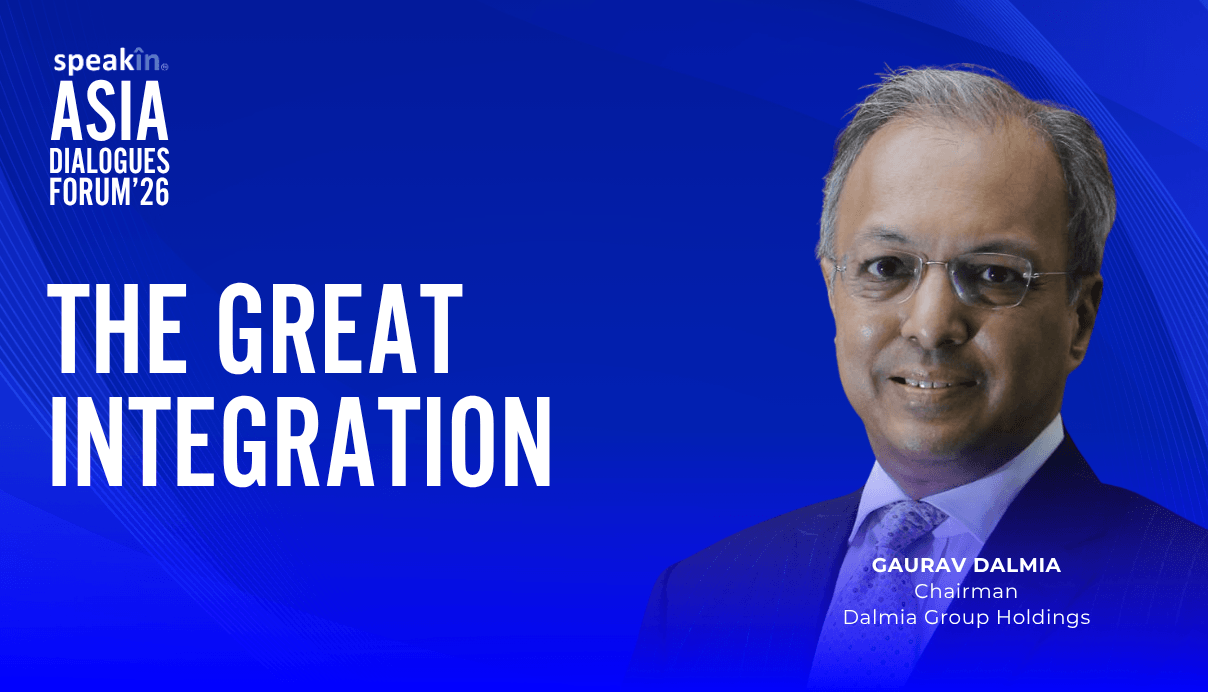
New Delhi brings a distinctive lens to the technology conversation. Unlike Bengaluru's engineering culture or Mumbai's financial orientation, its strength lies at the intersection of regulation and innovation, media and narrative, and long-cycle strategic thinking. The February 2026 edition of the SpeakIn Asia Dialogues Forum, moderated by SpeakIn founder Deepshikha Kumar Anand with Gaurav Dalmia of Dalmia Group as chief guest, reflected that character. Its shared conviction was that AI is not the disruption. How organisations respond to it is.
Dalmia traced lessons from four decades of business and investing, beginning with a Bankers Trust advertisement that has stayed with him since the 1980s.
"The greatest risk of all is taking no risk at all. Good management is a product in itself. I learned both ambition and humility from the rise and fall of GE." Gaurav Dalmia, Chairman, Dalmia Group of Holdings
His decade-by-decade framework moved from the ambition of the 1980s, through the shift from domain expertise to team management in the 1990s, to the anti-fragility of the 2020s. His most provocative point concerned AI infrastructure. In the telecom capex boom of the early 2000s, infrastructure providers struggled while application companies such as Google and Amazon created most of the wealth. Dalmia argued that the AI era is likely to follow the same pattern, with the application layer rather than the infrastructure layer creating the most durable value.
The forum's most actionable consensus came from Anurag Jain, Chief Digital and Technology Officer at KFC India, Yum! Brands. Organisations fail at AI, he argued, when business strategy, technology strategy and talent strategy are treated as separate workstreams rather than designed together from the outset. He also distinguished operational ROI, such as cost and speed, from strategic ROI: the ability to attract the best talent, build competitive moats and survive the next decade. The best technology integrations, he added, disappear into day-to-day work, whether that is a kitchen display system sequencing orders or a credit model assessing applications in the background.
Jain and Tarun Anand, Group CIO of Jakson Group, both named data maturity as the silent killer of AI ambition. Jakson's response was to centralise its data into a single system before scaling generative AI. Anand reminded the room that AI is not new, dating back to 1955. What has changed is the data. He encouraged leaders to view AI as a junior partner, and shared how a very junior employee built a complete tender costing application in 15 days at a fraction of the traditional cost. When the barrier between idea and execution collapses, everyone in the organisation must be able to build with AI.
Each sector brought its own reckoning. Barun Jha of Press Trust of India observed that journalists who only reproduce press releases or correct grammar are being replaced, while those who investigate and analyse are more valuable than ever. Rohit Shukla of Khaitan & Co described weekend hackathons in which lawyers co-developed tools with technologists, producing solutions lawyers actually use. Akshansh Yadav of iTV Network argued that India's opportunity lies in building for its 1.4 billion users rather than imitating Western products, citing an AI tool that helps citizens draft rent agreements and obtain FIR copies without intermediaries. Rajeev Jha, CISO of Comviva, added the forum's most urgent caution: as AI agent platforms multiply, every leader and developer must be security-aware.
Dr. Padmakumar Nair of Thapar Institute framed education around three goals for the AI age: self-knowing, intellectual humility and empathy-driven excellence. The future, he argued, belongs to those who can abstract simple rules from small sets of data in ethically challenging, cognitively complex situations.
The forum's imperatives followed naturally. Design business, technology and talent strategy together. Measure AI by strategic ROI, not only cost savings. Embed technology in process rather than layering it on top. Invest in data maturity first. Build for India. And cultivate empathy, intellectual humility and critical thinking as competencies AI cannot replicate. As Dalmia reminded the room, the greatest risk of all is taking no risk at all.

Read the White Paper
Flip through the Asia Dialogues Forum 2026 New Delhi white paper right here, or download the PDF to read later.
The Great Integration: New Delhi White Paper
Preparing the white paper…
The page-turning reader couldn’t load in this browser. You can still open or download the full white paper.
Open the white paper in a new tabDrag a page corner, click the arrows, or use ← → keys to turn pages.

Our Partners
Leading brands who have partnered with us.



Latest News
Latest updates, insights, and highlights from our leadership community