Asia Dialogues



The Great Integration: Technology, Talent, and Transformation in Asia (Pune Edition)
Sixteen senior leaders from fintech, healthcare, manufacturing, media, banking and professional services met in Pune to explore how India's organisations are navigating the shift brought by artificial intelligence and changing workforce expectations.
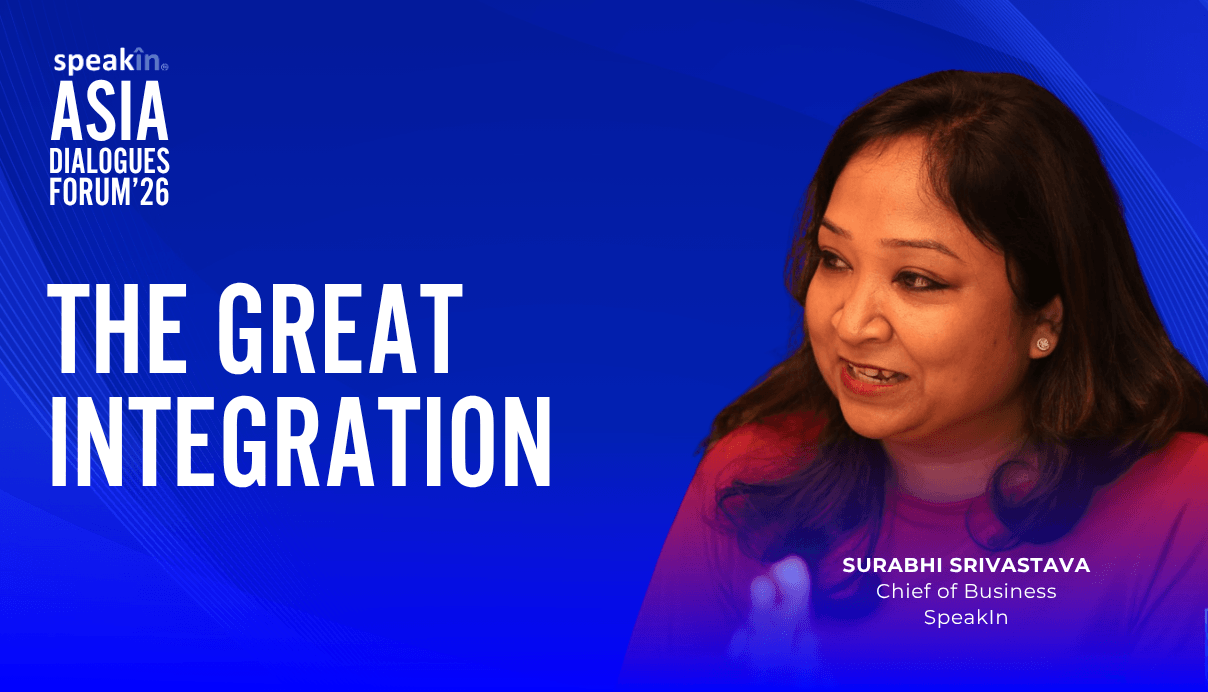
Pune sits at a distinctive crossroads. It is India's automotive heartland, home to more than 4,000 auto component manufacturers, and also one of the country's fastest-growing IT and GCC destinations, with over 400,000 IT professionals. That industrial and digital duality made it a fitting setting for the February 2026 edition of the SpeakIn Asia Dialogues Forum, where leaders identified three irreversible shifts: AI moving from pilot to production, the traditional job description giving way to skills marketplaces, and the realisation that technology without cultural change is bound to fail.
The forum's sharpest distinction came early. Roshni Parkhi, Head of Human Resources, India, at Allvue Systems, argued that organisations are confusing installation with integration.
"Simply adding a tool is not integration. It's more like an installation. Organisations need to identify roles that can be meaningfully enhanced by AI, and instead of traditional skill sets, look for an AI mindset, adaptability, and a quick ability to learn and adopt." Roshni Parkhi, Head of Human Resources, India, Allvue Systems
That shift is already changing how organisations hire. Harsha Vanvari Peter of Cornerstone OnDemand described how her company has done away with fixed job descriptions altogether, replacing them with career pathing and an internal talent marketplace. Dr. Vikas Prasad of Webasto Roofsystems India offered a historical parallel: twenty years ago, English proficiency was a differentiating skill, and today it is a baseline. AI literacy is following the same path, and those who fail to climb into the competency bracket may find AI absorbing their roles.
If one theme united every speaker, it was culture. Denu Thomas of Grant Medical Foundation, Ruby Hall Clinic, put it plainly: technology without cultural change is of no use. Technology should reduce decision latency, human fatigue and human error, but the culture must shift first. Manisha Prasad of CRIF India shared how her team deliberately avoids words like change and transformation, choosing optimise and efficient instead, and runs innovation contests so that employees generate ideas and the fear of job loss recedes. Naresh Kumar Pinisetti of Deepak Fertilisers drew on the Mahabharata, noting that Arjuna laid down his bow not because his weapons or techniques failed, but because his mindset did. The HR function's primary role in the AI era, he argued, is managing the human journey of change. He also cited Hyundai's experience with worker pushback over humanoid robots in Korea as a reminder that the social contract of automation must be written before the machines arrive.
Banking leaders described AI already in production. Sunil Gandhi, CIO for Treasury Technology at Deutsche Bank, reported that KYC processing has been compressed from days to minutes, machine learning liquidity forecasts have reached 92% accuracy, and intent-based coding has delivered 10 to 15% engineering efficiency gains. Data quality, he stressed, remains the most crucial factor. Subhayu Mukharji of PwC argued that India's two decades as the world's back office have built unmatched process expertise in hire-to-retire, procure-to-pay and record-to-report, a strategic asset in an AI-first world. Kedar Deo of Tech Mahindra framed the goal as decision velocity.
The forum's most unsettling prediction came from Sajith Chakkingal of Anthesis Group, who warned that AI will absorb the bottom three entry-level rungs of the corporate ladder, leaving academia to produce graduates ready to begin at the fourth. Captain Shantanu Chakrabarti of Suzlon Group predicted that traditional HR platforms will dissolve into islands of agents that plug into organisations on demand. Dr. W. Kumar of Thapar University described how research-embedded undergraduate education is preparing students for that ambiguity.
Responsibility ran through the discussion. Vikas Madhok, Global CISO of Lentra, argued that AI should be adopted for only two reasons, to solve a problem or to create an opportunity, with human oversight preserved in decision-making. Kedar Deo warned that IT, already responsible for around 5% of global emissions, could see that share rise sharply without efficiency-first architecture.
The forum's conclusion was that the organisations that win will not be those with the best algorithms, but those with the most adaptive cultures and the clearest sense of what meaningful enhancement by AI means for every role. Leaders called for auditing AI readiness at every level, adopting the language of optimisation to reduce friction, partnering with academia on step-four readiness, embedding cybersecurity and sustainability from day one, and accelerating the move to skill-based organisations. Pune has the industrial heritage, academic infrastructure and human capital to lead. The choices made in the next 24 months will decide whether it does.

Read the White Paper
Flip through the Asia Dialogues Forum 2026 Pune white paper right here, or download the PDF to read later.
The Great Integration: Pune White Paper
Preparing the white paper…
The page-turning reader couldn’t load in this browser. You can still open or download the full white paper.
Open the white paper in a new tabDrag a page corner, click the arrows, or use ← → keys to turn pages.

Our Partners
Leading brands who have partnered with us.


Latest News
Latest updates, insights, and highlights from our leadership community