Asia Dialogues



Capability Building in India's DeepTech Era (Bengaluru Edition)
Twenty leaders from deep technology, AI, manufacturing, defence and education gathered in Bengaluru for a frank conversation about what it will genuinely take for India to become a technology creator nation.
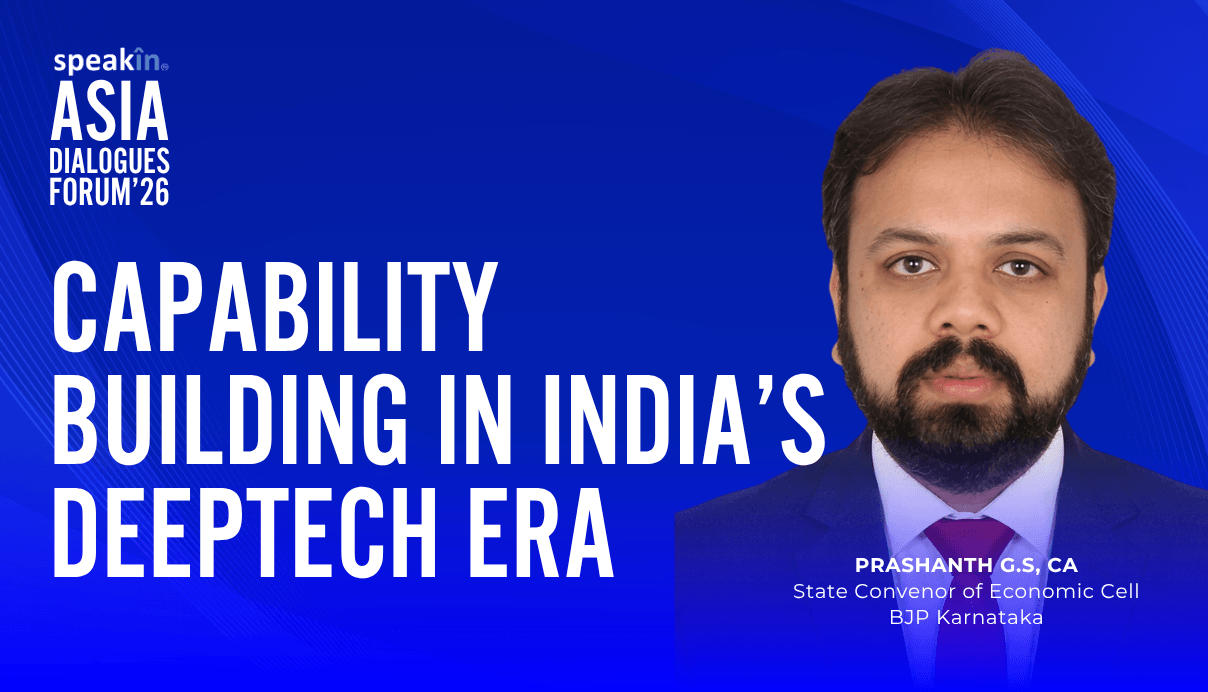
For decades, India built a global reputation as the world's back office, a services superpower that executed brilliantly for others. The April 2026 Bengaluru edition of the SpeakIn Asia Dialogues Forum asked a different question. It is no longer whether India can build, but whether it has the capital, the culture, the collaboration and the courage to build for itself.
The forum's diagnosis was candid. India has world-class engineering talent, accelerating policy momentum and a proven digital infrastructure foundation, yet remains structurally under-equipped for the deep tech era. India spends around 0.64% of GDP on research and development, compared with 3.48% in the United States, 2.43% in China and 4.91% in South Korea, and the private sector contributes only about 36% of that spend. Deep tech startup funding in India reached about USD 2.3 billion in 2025, up 37% on the previous year, while US deep tech raised more than USD 147 billion.
Pramod Agrawal of Seismic opened provocatively, arguing that India had been "lazy as a nation" in recognising the global shift and had "completely missed the boat" on the first AI wave. The claim was contested but not dismissed. Saurabh Jha of Tech Mahindra argued that the gap reflects not only money but national ambition and the willingness to invest across ten-year timelines.
Others pointed to genuine momentum. Vinod Shankar of Java Capital cited investments in machine vision, photonics and space technology, and argued that policies such as the 2020 space policy, the PLI scheme, the semiconductor mission and the national deep tech framework under the Anusandhan National Research Foundation have created conditions that did not exist five years ago. Prashanth G.S. highlighted longer tax exemptions for deep tech startups and a planned Rs 1 lakh crore fund for research and innovation, while Kumaran Venkatesh of Astrome Technologies noted the arrival of long-tenure, low-interest debt as patient capital. Ankush Tiwari of pi-labs.ai made the case for a defence-first path, observing that the internet and GPS both began as defence projects and that building where lives depend on reliability forces world-class discipline.
On AI, Kiran Kumar of Taggd reframed the debate. AI is not an opportunity risk, since the opportunity is clear. It is an execution risk, because India largely builds applications on infrastructure owned by others. India's Digital Public Infrastructure shows what becomes possible when the country owns the outcome. Raman Srinivasan of InMobi offered evidence that Indian IP can scale globally, with InMobi serving around 50 billion ads a day across two billion devices. Sandeep Menon of Workato pointed to the integration of new AI with legacy enterprise systems as an underserved opportunity, where India's two decades of process knowledge become a genuine moat.
Anshuman Tiwari of GSK identified the group most often overlooked: mid-career managers, who need reskilling most and receive it least. He likened enterprise AI transformation to "performing heart surgery while the patient is swimming", and warned that most programmes still focus on generative AI when the real shift is toward agentic AI.
The ecosystem conversation centred on capital and collaboration. Shankar identified the tightest constraint as a USD 20 to 40 million funding gap at the stage when proven prototypes need to become products. Sivakumar Selva Ganapathy of Johnson Controls proposed government procurement as a deliberate demand signal for Indian deep tech, and Roopa Jayaraman of Odessa cited IIT Madras as a model of academia, industry and government working toward shared outcomes. Gokul N A of CynLr described the frustration of training deep tech talent for years only to lose it to study abroad, while Vijay Gurumurthy of Brillio shared a three-month AI internship that produced 150 to 160 practical use cases.
Education closed the discussion. Venkataramana Mantha of Expleo warned against sacrificing physics and engineering fundamentals in the rush to teach AI. Dr. Padmakumar Nair of Thapar Institute urged students to ask who they are, what is changing around them, and what their dream for humanity is.
The forum's conclusion was that the next 24 months will determine India's trajectory. Making IP creation the default rather than billable hours, closing the scale-up funding gap with patient capital, using public procurement as a demand signal, reskilling the middle and protecting engineering foundations are the choices that will decide whether India becomes a technology creator nation.

Read the White Paper
Flip through the Asia Dialogues Forum 2026 Bengaluru white paper right here, or download the PDF to read later.
Capability Building in India’s DeepTech Era: Bengaluru White Paper
Preparing the white paper…
The page-turning reader couldn’t load in this browser. You can still open or download the full white paper.
Open the white paper in a new tabDrag a page corner, click the arrows, or use ← → keys to turn pages.

Our Partners
Leading brands who have partnered with us.



Latest News
Latest updates, insights, and highlights from our leadership community