Asia Dialogues



Capability Building in India's DeepTech Era (Hyderabad Edition)
Twenty-eight leaders from technology, manufacturing, defence, education and government met in Hyderabad, India's fastest-growing GCC hub, to ask whether the city's global capability can now become sovereign capability.
Hyderabad is no longer simply India's IT capital. It added 40 new Global Capability Centres in 2025, more than any other Indian city, now hosts around a fifth of India's GCC base, and is home to some of the largest campuses of global technology companies outside the United States. Yet the April 2026 Hyderabad edition of the SpeakIn Asia Dialogues Forum did not convene to celebrate that momentum. It convened to interrogate it. Hyderabad has become extraordinarily good at building capability for others. The forum asked whether it can now do the same for itself.
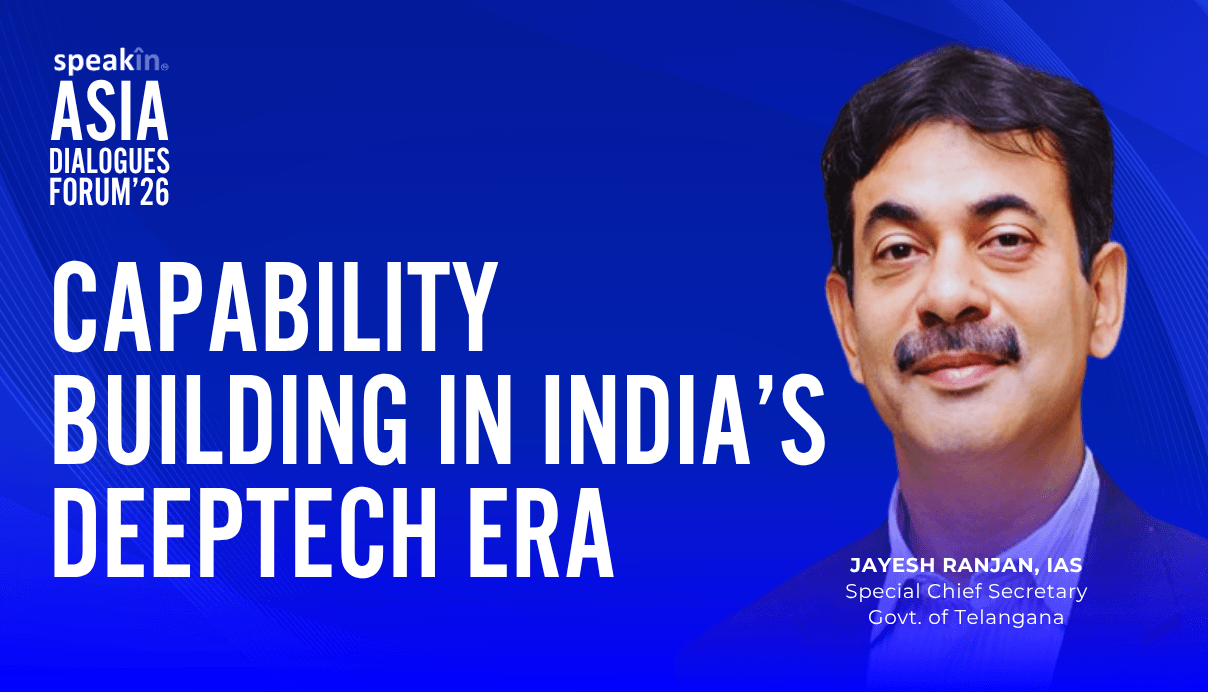
Jayesh Ranjan, Special Chief Secretary of the Telangana Government, set out the state's Telangana Rising vision: a USD 3 trillion economy by 2047, roughly a sixfold expansion. Hyderabad, he said, has moved from services to leadership in GCCs and engineering R&D, and must now pivot toward deep tech innovation. He outlined the government's role in that shift, from skilling through the Telangana Academy for Skills and Knowledge, which co-designs practical modules with global technology partners, to centres of excellence, responsible AI governance, affordable supercomputing for startups and acting as first customer for indigenous solutions. Several participants cited the TASK model as one of India's most replicable workforce innovations.
Chari TVT laid out the paradox at the heart of the city's success. Indians lead many of the world's largest technology companies. UPI processes billions of transactions a month. Chandrayaan-3 landed on the moon. Yet India has not produced a global product brand comparable to the software giants it serves. The aspiration, he argued, should be to move from polishing diamonds to creating them. Veerender Bhimavarapu of Synoptek noted that around 53% of India's IT services are exported to the US, with the intellectual property owned almost entirely offshore. Sriram Karri of the Telangana Government challenged the room on a culture that expects excellence in cricket but tolerates mediocrity elsewhere.
"India has become rich through software exports. But we are not yet powerful." Nagasai Pallapotu, Senior Director of Engineering, Kore.ai
Being rich, participants concluded, means being able to buy. Being powerful means being able to build what others cannot, or will not, sell.
Security brought urgency to the discussion. Rohit Ponnapalli, CISO of Cloud4C, warned that quantum computing threatens the encryption protecting today's financial and government systems, and that adversaries can harvest encrypted data now to decrypt it later. India, he noted, relies heavily on foreign cybersecurity products, and procurement rules that favour established global vendors shut out Indian startups regardless of merit. PachaiMuthu Muthusamy of General Datum described post-quantum migration as a national imperative.
On AI hardware, Vijayavardhan B of Morphing Machines argued that India should not chase GPU manufacturing. The real bottleneck in AI compute is moving data rather than arithmetic, and reconfigurable architectures and power-efficient software play to India's engineering strengths. Shashank Sahni of Google India observed that significant engineering behind global products is already done in India. The question is who owns the outcome.
Defence featured prominently. P Hani of Edgeforce Solutions described warfare shifting from man against man to machine against machine and called for defence technology to enter engineering curricula. Kamalakar LVV of Power Dynamics warned that conflict in East Asia could create a semiconductor chokepoint, while Phani Pothula of Honeywell showed how Hyderabad's avionics capability took two decades to build. Amrit Pati of Schiebel identified patient capital as the binding constraint, since defence deep tech requires five to ten years to mature.
Participants also proposed ways to strengthen the ecosystem. Anay Pathak of VAST Data suggested measuring research by commercial licences rather than patents filed. Amit Varma of Shaiva Group described a USD 50 million commitment to Indian technology. Sujeet Kumar of Cyient challenged leaders to buy Indian products, and Radhika Chennakeshavula of Silicon Labs argued that jugaad cannot substitute for systematic engineering.
The forum's direction was clear: redirect GCC momentum toward Indian IP creation, build quantum-resilient security and a domestic cybersecurity industry, create patient capital for defence and aerospace, bring national security into engineering education and scale the TASK model nationally. Hyderabad has built the capability. The next step is ownership.

Read the White Paper
Flip through the Asia Dialogues Forum 2026 Hyderabad white paper right here, or download the PDF to read later.
Capability Building in India’s DeepTech Era: Hyderabad White Paper
Preparing the white paper…
The page-turning reader couldn’t load in this browser. You can still open or download the full white paper.
Open the white paper in a new tabDrag a page corner, click the arrows, or use ← → keys to turn pages.

Our Partners
Leading brands who have partnered with us.



Latest News
Latest updates, insights, and highlights from our leadership community