Asia Dialogues



Rewriting the Rules of Attention: How Leaders Are Building Influence and Impact in an AI-First Era
Twenty-eight leaders from marketing, brand strategy, technology, financial services, business and people functions met at Sofitel Mumbai to ask what it takes to build trust, relevance and lasting influence when AI makes content infinite.
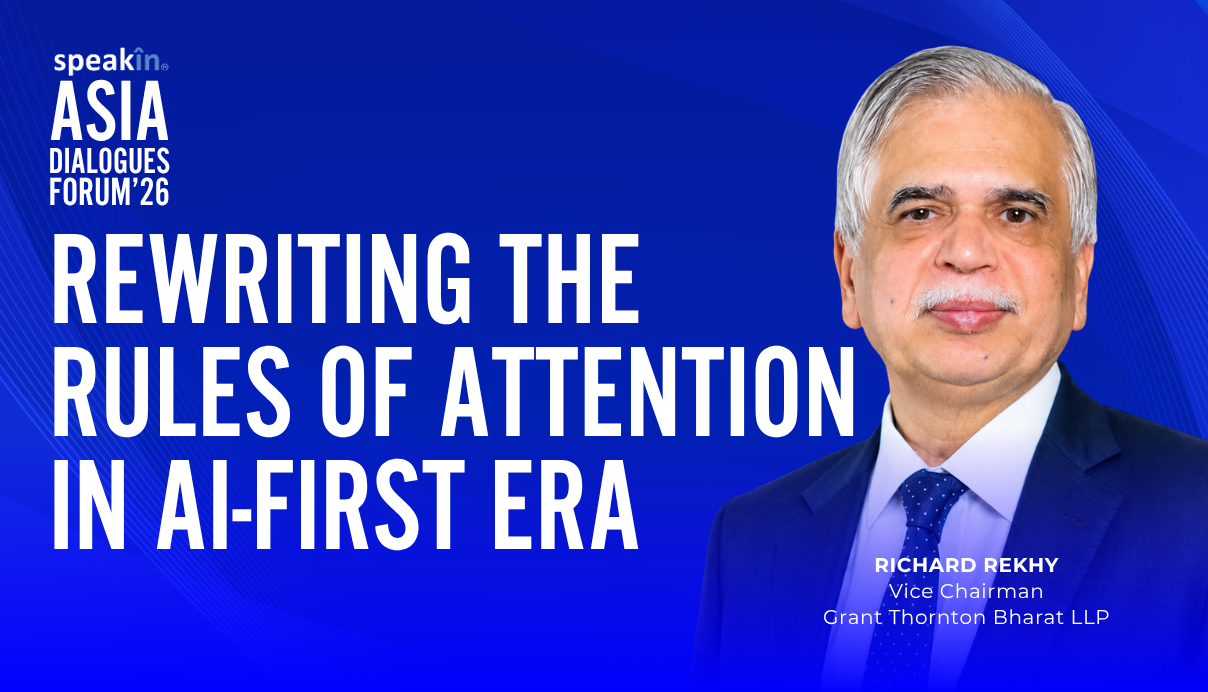
AI has made it easier than ever to create content, and harder than ever to be heard. That paradox framed the Mumbai edition of the SpeakIn Asia Dialogues Forum 2026, held on 9 June with People Matters as media partner. Leaders from TCS, Grant Thornton Bharat, NSE, Akasa Air, ICICI Lombard, Amway, JioStar, Quora, BDO India and SPJIMR arrived at a conclusion that was simple and difficult in equal measure. The tools have changed entirely. The destination has not. Attention can be manufactured. Trust cannot.
India is both the world's largest opportunity for brand building and one of its most contested attention environments, with around 900 million internet users and digital advertising spend estimated at more than Rs 49,000 crore in 2025. Industry research cited at the forum suggests that more than nine in ten large marketing teams now use AI for content, and that content production has multiplied with little increase in budget. Yet audiences now encounter thousands of pieces of content each day, and the ability to command genuine attention has become increasingly elusive.
The most consistent insight of the evening was that organisations have been optimising for the wrong metric. Clicks, impressions and reach are measurable and therefore managed. Trust is harder to quantify and therefore underinvested. The 2025 Edelman Trust Barometer special report on brand trust found that, for the first time, trust ranks alongside price and quality in purchase decisions. Richard Rekhy of Grant Thornton Bharat grounded the point in history, recalling how Arthur Andersen, built over decades, disappeared in about 45 days. Trust earned over a lifetime can collapse faster than any communications strategy can respond.
Participants returned repeatedly to the question of what AI cannot do. It can accelerate production, reduce the cost of execution, synthesise research and personalise at scale. It cannot decide what is worth saying, supply an authentic point of view or create the human credibility that makes audiences believe the source. AI scales execution. It cannot scale judgement.
The forum also highlighted the internal dimension of trust. Brands that go to market before their own people believe in the message consistently underperform, because the gap between what a brand claims and what its people signal is immediately visible. Employee voices are trusted far more than corporate messaging, making internal alignment one of the highest-return investments a brand can make.
Leadership visibility has become a strategic asset in its own right. The era of the invisible CEO who lets the brand speak while staying carefully neutral is ending. Audiences, particularly those under 40, place growing trust in individuals rather than institutions and quickly detect when a leader's voice is performative. Participants argued for executive thought leadership grounded in real expertise rather than ghostwritten positioning, and for leaders willing to share views even on uncomfortable issues.
The same logic applies to influence marketing. Participants observed a decisive shift away from celebrity reach toward micro and nano creators who genuinely believe in what they promote and typically deliver stronger engagement and recall. The forum also discussed the SAVE framework of Solution, Access, Value and Education as a customer-first alternative to the traditional four Ps of marketing.
The forum's synthesis contrasted two approaches. The AI-first trap optimises for reach, produces more content at lower cost, relies on celebrity amplification and lets AI generate the brand voice. The influence-first alternative builds for trust, creates less content with stronger conviction, uses authentic voices, directs AI with a clear human perspective and secures internal conviction before going to market.
The leaders who were winning in the room were not those with the largest budgets or the most sophisticated AI stacks. They were those who had answered the harder questions first: what do we actually stand for, do our own people believe it, and are the voices we amplify genuinely aligned with it? The forum's recommendations followed from those questions: measure trust, recall and advocacy alongside reach, invest in leadership voice before brand voice, build internal alignment before external campaigns, and direct AI with conviction so that every piece of content carries a genuinely human point of view.

Our Partners
Leading brands who have partnered with us.




Latest News
Latest updates, insights, and highlights from our leadership community