Asia Dialogues



Leading Without Certainty: Anu Rathninde on What Complexity Demands of Leaders
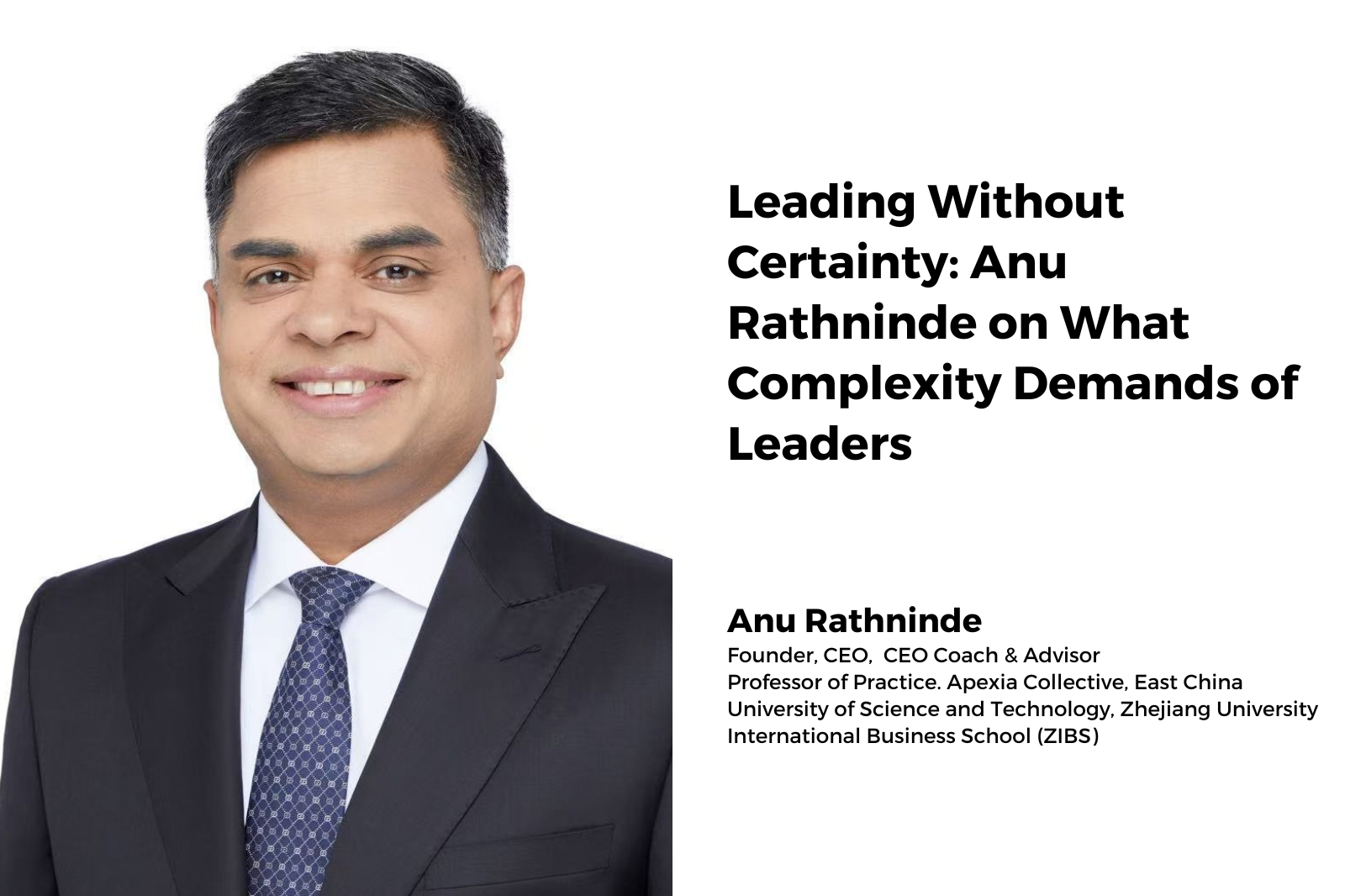
Ask most global executives to name the hardest part of running a business across borders, and they will tell you that it is culture — the languages, the unspoken rules of hierarchy, the diplomacy required to run the same playbook in Shanghai, Zurich, and Mumbai. Anu Rathninde has spent three decades quietly proving them wrong.
Rathninde has built and rebuilt businesses across Asia, Europe, and the United States, at one point running a multibillion-dollar enterprise with more than thirty thousand employees, a ground-level education in what it actually takes to align people and operations at scale, across regulatory regimes and cultural silos.
And his conclusion is that the differences that appear to divide organizations are rarely the real problem. The real problem is the absence of clarity.
"Every human being comes to contribute and earn a living," he says. "Nobody comes to work wanting to make things difficult. Every customer, everywhere, wants one thing — the work you promised, delivered well." He describes himself as colour-blind: he does not see a Chinese colleague, a Swiss colleague, an Indian colleague, only a person with a job to do.
It's a deceptively simple stance, but it's the foundation of his leadership philosophy built from the ground up, literally: on farms, factory floors, and in boardrooms on three continents.
A childhood steeped in uncertainty
Rathninde was one of eight siblings, raised in a farming community in Sri Lanka, where uncertainty was the weather. During the monsoons, the young Anu saw farmers, holding umbrellas or banana leaves overhead, hurry to his home to seek his father’s advice on what to plant the next day. There were no fixed weather forecasts. Nor did his father have access to complete information. But that never stopped him from making a decision. He made the best call he could with what he knew, and if it later proved wrong, he dealt with that when it came.
That habit of embracing uncertainty became, decades later, the organizing principle of Rathninde's own leadership philosophy, and the theme of his book, "Tackling Complexity: Tough-Love Interactions to Navigate Uncertainty, Promote Positivity, and Deliver Performance Excellence."
His father also gave him a gurumatra that has outlasted every role he has had: "Never ask somebody to do something that you cannot do yourself."
Detail, Rathninde says, is knowledge, and knowledge is power — why he insisted, at every stage of his career, on getting into the trenches and learning from the ground up.
But knowledge begins, he says, with temperament: the hunger to always grow better, the humility to admit what you do not know, and the willingness to keep learning.
The organization is not a machine
Traditional management approaches organization like a machine: analyze the parts, pull the right lever, and get the desired outcome. That logic may solve a technical problem, but, when applied to a living, breathing organization, it can become dangerous.
Rathninde argues that organizations are evolving, complex adaptive systems in which employees, customers, technologies, suppliers, and decisions continually influence one another.
A formula that transformed one business may fail in another because the underlying relationships and context differ.
For Rathninde, experience should therefore produce better questions rather than greater certainty.
He offers, as evidence, an episode from early in his career, when he was sent to take over an Indian business running three plants. His CEO wanted one shut immediately, as the first move; Rathninde asked for three months to understand the business before making a decision that could not be undone. The CEO resisted, but Rathninde got his extension and used it to learn the operation from the ground up. The plant never had to shut down and subsequently went on to grow from roughly $40 million in revenue to $800 million.
"Complexity means the outcome is uncertain," he says. "There is no fixed formula. The biggest mistake I see leaders make is assuming they already know the outcome."
The same blindness, he argues, shows up in how businesses are structured and not just in how they're run.
In many traditional and founder-led companies, a pattern he considers especially characteristic of Asia and India is that the founder has spent decades living and breathing the business. That resultant intimacy is an asset until the day a professional CEO is finally brought in, at which point it becomes a liability: the founder struggles to transfer knowledge or simply can't let go of control. The organization enjoys the systemic stability, but scalability suffers.
The US, in Rathninde's view, has the mirror-image problem — CEO tenures there now often run just three or four years, which supplies plenty of fresh thinking but makes genuine stability hard to build.
From control to continuous adaptation
If there is no fixed formula, what replaces one?
Rathninde's answer is SIILA: Systems Thinking, Internalize, Interact, Learn, and Adapt, a sequential map.
Leaders first see the interconnections around them, then turn the same scrutiny on their own values and fears, before interacting across the organization, discovering what they don't yet know, learning from how the system responds, and adapting accordingly.
It is a discipline for operating in the permanent absence of certainty, and it is where he draws a line between "tough love" and simple control. Toughness without respect produces fear; care without candor lets problems metastasize quietly. Tough love means telling people the truth while remaining, unmistakably, on their side.
The goal is developing better judgment in the people around him, not obedience.
Culture, character and the shadow of the leader
Having worked across continents, Rathninde has developed an allergy to cultural shorthand.
Culture matters, he says, but it never explains the whole of a person. According to him, leaders shape organizations less through policy than through the accumulation of their own daily conduct.
He likes to quote Confucius: "When a prince's personal conduct is correct, his government is effective without the issuing of orders. If his personal conduct is not correct, he may issue orders, but they will not be followed."
Start every meeting on time, he says, and the whole team eventually learns punctuality without being told. "The shadow of the leader affects the whole organization."
What travels across every culture he has worked in is a blend of much plainer virtues: clarity, respect, and consistency.
A leader who keeps his values as the anchor, starting with his day-to-day commitments and applying standards fairly, ends up defining the organization more decisively than any strategy document could. And those values are tested hardest when the easy decision and the responsible one diverge. By Rathninde's account, roughly 40 percent of CEOs who are fired are fired for ethical reasons rather than performance reasons. Authenticity, therefore, in his words, is reducing the distance between the values a leader publicly announces and the choices he makes when no one is applauding.
The question that still defeats him
Rathninde is candid about one question he is still trying to figure out: why so many leaders fall into a kind of depression after leaving their jobs or roles.
One man missed the paycheck arriving every month; another missed being the one who told people what to do. Underneath both, Rathninde suspects, is the same absence of a purpose that was never bigger than the role.
Money matters early on, but purpose has to grow with a person until it becomes larger than they are, or losing the title becomes losing the self.
It's why he believes education needs reform. Schools prepare people to earn a living, but do little to help them find a deeper purpose that runs like an undercurrent through all they do, making their lives more meaningful and fulfilling.
And it's why, when asked what he hopes his next chapter will change in leaders, he wants to help people find their purpose and make it visible — closing the gap he sees in too many CEOs who wear the role like a costume rather than living it as part of who they are.
The Road Ahead
The job of chief executive is an intensely lonely, perpetually precarious, and stressful position, and the one finally accountable for everything. Those who do seek help only get it in fragments: consultants who advise and leave, academics who only theorize; coaches who inspire without accountability.
Roughly 90 percent of corporate transformations fail, and Rathninde believes that the disconnect between advice and execution is the quiet killer behind most of them. Closing it has become his mission: working alongside CEOs by bringing together research rigor, thirty years of lived operating experience, and the discipline to see execution through.
Leadership & AI
His conviction that leadership is best approached as daily self-management rather than control over others runs through everything he does now, as coach, speaker, professor of practice, and author, and shapes his view of what AI will do to the profession.
AI can already analyze information and produce monitoring reports and planning documents better than we can. So, if the management role is mostly control and information transfer, much of it is headed for automation.
But AI cannot determine purpose, carry moral responsibility, rebuild trust after a painful decision, or develop another person through uncertainty. It can sharpen judgment, but cannot be held accountable for it.
The opportunity, according to Rathninde, is to spend the time AI frees up on the task leadership should have prioritized all along — developing people, connecting silos, and closing the gap between strategy and execution.
The future will belong to leaders who can work amidst uncertainty without becoming paralyzed or reaching for control as a substitute for understanding.
"Leadership is never about managing others," he says. "It is about managing yourself." Everything else follows from that.
 You might be interested in




Our Partners
Leading brands who have partnered with us.










Latest News
Latest updates, insights, and highlights from our leadership community